AI ENGINEERING · ARCHITECTURE · GOVERNANCE
AI in production.
Decisions in perspective.
Notes on building, observing and governing AI systems. From agent architectures to the decisions that need to hold up in production.
Explore the articles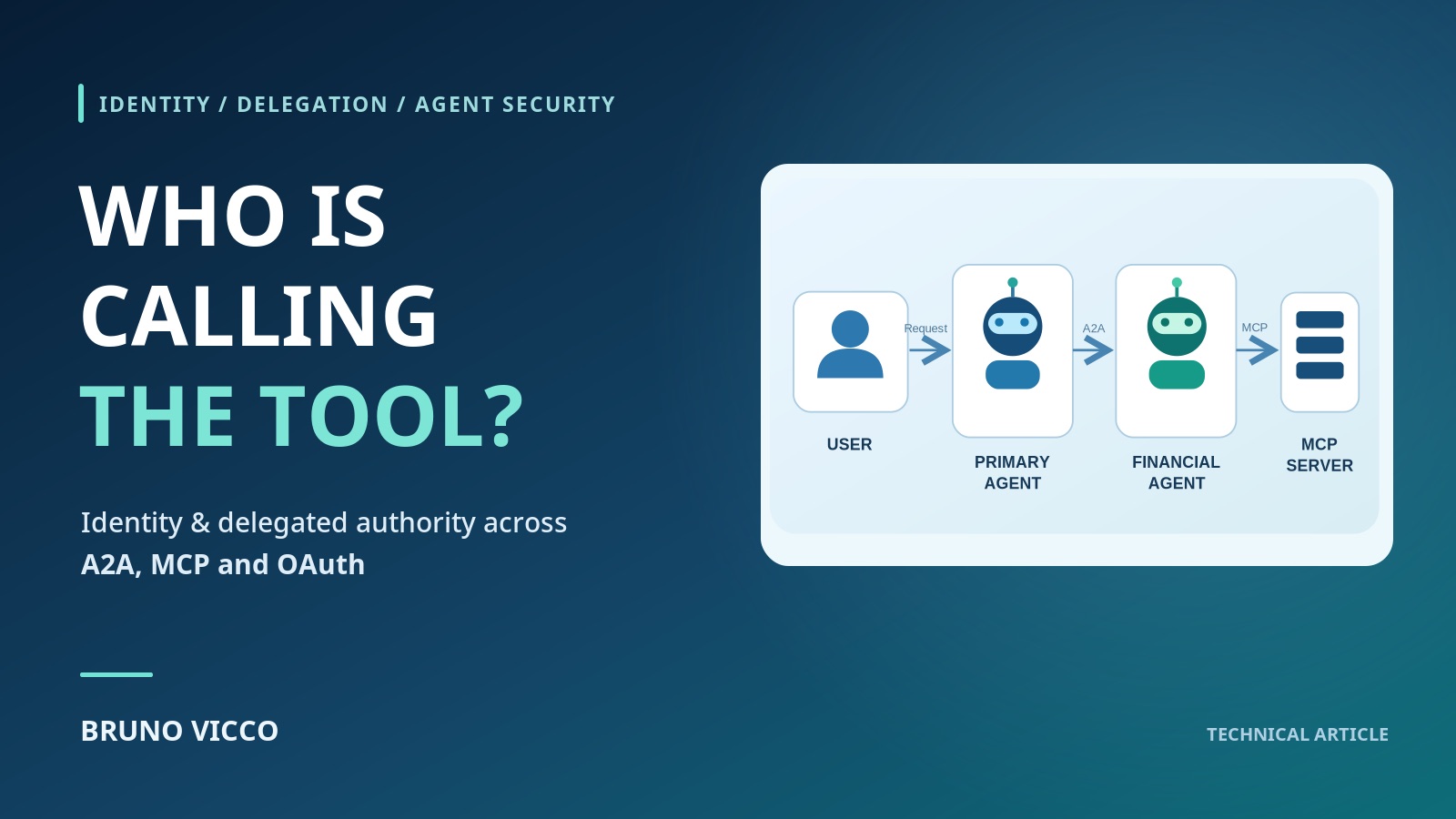
Who is calling the tool?
In the previous article on autonomy and authority, I explored the difference between allowing an agent to choose a task's next steps and granting it authority to produce external effects. I used the Controlled Autonomy Lab as an…
Security · Architecture & agents · 10 min readRead article →READING TRACKS
Tracks
Sequences of articles that build on each other, meant to be read in order.
- 016 articles
Generative AI in a regulated financial institution
Six parts on adopting generative AI where the standard is demonstrability: regulation, frameworks, architecture, development workflow and harness.
- 024 articles
State and identity in multi-agent systems
Why multi-agent systems break in state and execution identity before the prompt, and how to choose and combine LangGraph, Agno and CrewAI.
- 033 articles
Controlled autonomy and authority
From six architecture patterns to the line between an agent's decision and its right to act, and who is actually calling the tool.
- 042 articles
Measuring engineering in the age of agents
Why tokens fail as a productivity metric, and how DORA, developer experience and cohorts can measure the real impact of AI.
- 0510 articles
Building a conversational assistant: LangGraph, DSPy and Redis
A production assistant component by component, from memory and Redis modelling to routers, DSPy, guardrails, observability, and the full pipeline.
- 064 articles
Enterprise AI security
A four-part series: terms of service and data privacy, platform security features, proactive threat detection, and end-to-end governance.
- 074 articles
AI provider dependency, cost and resilience
Resilient architectures, the cost of AI, concentration risk, and regulated infrastructure in Brazil.
- 083 articles
AI regulation: EU and USA
The EU AI Act, the fragmented US approach, and a side-by-side comparison.
- 095 articles
Foundations: RAG, prompting and fine-tuning
The core techniques for adapting LLMs, and how to choose between them.
THE LIBRARY
All articles48
Ideas, experiments and engineering decisions, in Portuguese and English.
- 01↗
Who is calling the tool?
In the previous article on autonomy and authority, I explored the difference between allowing an agent to choose a task's next steps and granting it authority to produce external effects. I used the Controlled Autonomy Lab as an…
10 min read Translated from Portuguese - 02↗
Agentic SDLC as a platform: what needs to exist between the coding agent and the merge
When a coding agent starts participating in development, it enters a process that already has identity, repositories, dependencies, execution environments, tests, branch policies, CI/CD, and rules for promoting changes.
9 min read Translated from Portuguese - 03↗
Autonomy is not authority: where agent decisions end and the right to act begins
In the Controlled Autonomy Lab, I implemented the same incident-analysis task using six architectures with different degrees of control and autonomy. The experiment's most autonomous pattern receives five tools and decides which to…
7 min read Translated from Portuguese - 04↗
DORA, Developer Experience, and cohorts: how I would measure AI’s impact on engineering
Part 2 of 2 - Measuring engineering in the age of agents
9 min read Translated from Portuguese - 05↗
Tokens as a productivity metric: where that interpretation breaks down
At a company where I worked, someone proposed using token consumption as one of the indicators for tracking LLMs' impact on developer productivity. The executive's reasoning started with data already available: the provider allowed…
7 min read Translated from Portuguese - 06↗
LangGraph, Agno, or CrewAI? Choosing the abstraction that fits the problem
After discussing continuity difficulties in hybrid architectures, it is worth examining a more basic question: when would I start with LangGraph, Agno, or CrewAI? The three frameworks overlap, and all have evolved considerably. A…
6 min read Translated from Portuguese - 07↗
Brazil, AI, and Regulated Infrastructure: The Next Challenge for Enterprise Adoption
Brazil is beginning to occupy a position that is hard to ignore in the global artificial intelligence market. According to data released by OpenAI in August 2026, the country is among ChatGPT's three largest markets by weekly active…
7 min read Translated from Portuguese - 08↗
LangGraph + Agno in the same application
After dealing with an architecture where LangGraph and Agno shared responsibilities without a sufficiently clear boundary, the decision in my case was ultimately to migrate the entire solution to LangGraph.
6 min read Translated from Portuguese - 09↗
Did your agent forget the conversation, or did your architecture lose execution identity?
After examining state and continuity in the first part of this series, one of the most frequent causes of strange behavior deserves separate attention: identity. In a stateful system, a request continues the previous story only if the…
4 min read Translated from Portuguese - 10↗
Multi-agent systems break in state before they break in the prompt
This series grew out of two very concrete situations. In one professional experience, I inherited a POC for a multi-agent architecture in which a supervisor built with LangGraph delegated work to agents implemented with Agno. The…
6 min read Translated from Portuguese - 11↗
6 LLM Architecture Patterns: Lessons from 234 Experimental Cells on Control and Autonomy
The idea for this study emerged while I was taking an Anthropic learning path, part of which covers choosing between augmented LLMs, workflows, and agents based on two aspects that seem simple but have important consequences in…
10 min read Translated from Portuguese - 12↗
One trace, multiple agents: distributed observability across A2A and MCP
While developing applications composed of multiple agents, I encountered a recurring observability problem. A request would start in an orchestrator, move to another agent over A2A, pass through an MCP service, and return to the…
5 min read Translated from Portuguese - 13↗
Concentration Risk in Generative AI
A governance analysis of resilience, redundancy, and the cost of diversifying AI providers.
20 min read Translated from Portuguese - 14↗
Harness engineering: how to make agents reliable
Agent = Model + Harness
10 min read Translated from Portuguese - 15↗
Spec-Driven Development with AI: Five Anti-Patterns and the Workflow That Makes Responses Traceable
Part 5 of 6 — Series: Generative AI in a Regulated Financial Institution
16 min read Translated from Portuguese - 16↗
Architecture: where policy becomes technical control and why data residency defines the design
From policy to technical control - Part 4 of "Generative AI in a Regulated Financial Institution".
14 min read Translated from Portuguese - 17↗
The AI bill has arrived: is limiting usage the answer?
Routing, throughput, and governance
16 min read Translated from Portuguese - 18↗
Frameworks in practice: NIST AI RMF, ISO 42001, OWASP, and GAIG translated into controls and evidence
There is a crucial difference between citing a framework in a Board presentation (or merely putting it in a policy) and implementing it so that an external auditor can verify it. The first is easy and fits on a slide; the second…
9 min read Translated from Portuguese - 19↗
The Brazilian Regulatory Maze: What BACEN, CVM, ANBIMA, and the LGPD Require Before the First Prompt
Part 2 of 6 in the series Generative AI in a Regulated Financial Institution.
13 min read Translated from Portuguese - 20↗
Generative AI in regulated environments
In a regulated financial institution, the criterion is not speed: it is demonstrability. This introduction establishes the thesis, the Product ≠ Provider principle, and the map of the next five parts.
7 min read Translated from Portuguese - 21↗
The Complete Pipeline: From User Text to the Formatted Response
Over the past few months, I have published separate posts about each component of the e-commerce conversational assistant: episodic memory, routers, DSPy, anaphora, Redis Stack, guardrails, observability, and QueryBuilder.
5 min read Translated from Portuguese - 22↗
Seven frameworks for governing LLM systems: the map before the territory
I've been working for twenty years in banking. One thing that this time taught me is that compliance and security frameworks don't exist for bureaucratic reasons, they exist because someone, at some point, paid a steep price for not…
10 min read - 23↗
QueryBuilder: turning a Pydantic object into a safe FT.SEARCH query
In the posts about Redis Stack, I showed the Fat/Slim/Hybrid model and how the modeling decision directly affects what the LLM receives. Today I want to show the layer between DSPy's RouterOutput and Redis: the QueryBuilder.
4 min read Translated from Portuguese - 24↗
dspy.Refine: runtime self-correction without recompiling the model
In the posts about DSPy, I showed how BootstrapFewShot compiles a router that classifies intent and extracts structured parameters. That is DSPy in offline mode: you compile once, version the JSON, and use it in production.
4 min read Translated from Portuguese - 25↗
Observability in a LangGraph Graph: What Langfuse Sees That Logs Do Not
In previous posts, I showed how DSPy classifies intent and how the custom embedding-based router decides the macro-intent. The two have one thing in common: they can degrade silently.
4 min read Translated from Portuguese - 26↗
Three routers, three different problems: DSPy, a custom Semantic Router, and Aurélio AI
In previous posts I showed how DSPy replaced Agno/LangGraph as an assistant's cognitive router, adding an output contract, a metric, and an improvement process on top of the LLM.
9 min read Translated from Portuguese - 27↗
DSPy in practice: what changes when the router is already an LLM but is not yet compilable
In the latest posts, I discussed data modeling in Redis Stack and DSPy as a framework that treats prompts as compilable code.
6 min read Translated from Portuguese - 28↗
Regulatory Guardrails in Investment Assistants: CVM, ANBIMA, and the LGPD Paradox
The other day, I discussed the taxonomy of memory (episodic, semantic, and procedural) and how each type requires a different infrastructure layer in a financial assistant.
4 min read Translated from Portuguese - 29↗
Memory in Agents: Episodic, Semantic, and Procedural
When you build a conversational assistant for e-commerce or a product catalog, the persistence question is technical: latency, cost, TTL.
5 min read Translated from Portuguese - 30↗
DSPy: the framework that treats prompts as compilable code, not strings
You know when a model version is about to be deprecated, or you need to switch to another provider's model, and that means adjusting your prompts to make them work? One of DSPy's purposes is to help with that pain point.
6 min read Translated from Portuguese - 31↗
Fat vs Slim vs Hybrid in Redis Stack: the model that changed how I think about LLM retrieval
(A continuation of the previous post. If you want the full context, start there.)
3 min read Translated from Portuguese - 32↗
Observability in AI
Imagine flying an airplane without navigation instruments—that is how many teams feel when deploying AI systems into production without a robust observability strategy. And, let's be honest, nobody wants their system to become a ticking…
8 min read Translated from Portuguese - 33↗
Resilient AI Architectures: Preparing for the Inevitable
Months of AI development, thousands invested—and at the most critical moment, your system freezes. This is not a hypothetical scenario. It happens. More often than you might think.
5 min read Translated from Portuguese - 34↗
Building an End-to-End AI Governance Framework
Part 4 of 4 in the AI Security for Enterprises Series
4 min read - 35↗
Proactive Security and Real-Time Threat Detection in AI Systems
Part 3 of 4 in the Enterprise AI Security Series
3 min read - 36↗
- 37↗
Understanding AI Security Fundamentals: Terms of Service and Data Privacy
Part 1 of 4 in the Enterprise AI Security Series
3 min read - 38↗
From RAG to Hybrid Architectures
The landscape of enterprise information retrieval is rapidly evolving beyond basic RAG implementations. While the foundational RAG approach revolutionized how AI systems access and utilize information, today's enterprise needs are…
3 min read - 39↗
Choosing the Right Approach: RAG, Prompt Engineering, or Fine-Tuning
In the landscape of generative AI and Large Language Models (LLMs), choosing the right technique for solving a particular problem can feel overwhelming. RAG, Prompt Engineering, and Fine-Tuning are three powerful tools in your AI…
3 min read - 40↗
Fine-tuning LLMs: A Deep Dive into Instruction Fine-tuning
As we navigate the evolving landscape of language models, fine-tuning has emerged as a crucial technique for adapting these powerful tools to specific needs. Through my experience focusing on instruction fine-tuning, combined with…
4 min read - 41↗
The Art and Science of Prompt Engineering: Unlocking LLM Potential
As Large Language Models (LLMs) continue to reshape our technological landscape, the role of prompt engineering has emerged as a crucial discipline at the intersection of human communication and artificial intelligence. In the past…
5 min read - 42↗
From Search to Generation: Unlocking the Power of Retrieval-Augmented Generation (RAG)
Imagine you're chatting with an AI assistant. You ask it a complex question, and rather than giving you vague, generic advice, it offers a detailed, accurate response grounded in real-world facts. The secret behind such a feat?…
4 min read - 43↗
From Theory to Practice: Building Enterprise AI Solutions with Teams Integration
After dedicating my efforts to developing and implementing AI solutions through Microsoft Teams, I've discovered that the true power of AI lies not in complex algorithms, but in practical, day-to-day applications that transform how…
1 min read - 44↗
AIOpsLab: Automating Cloud Operations
Microsoft Research has just introduced a significant innovation in cloud operations: AIOpsLab, a comprehensive framework for developing and evaluating AI agents for autonomous cloud operations.
2 min read Translated from Portuguese - 45↗
Meta Introduces Large Concept Models
The FAIR (Meta AI Research) team has just published research that redefines our understanding of language models. The new Large Concept Model (LCM) introduces a fundamentally different approach to how AI processes and generates content.
2 min read Translated from Portuguese - 46↗
Summary of AI Regulations: EU and USA
Last week, we explored the AI regulatory landscapes in the European Union and the United States. Today, let's dive deeper and compare these two approaches, highlighting the key aspects that set them apart.
2 min read - 47↗
AI Regulation in the USA: A Patchwork Approach
While the EU moves forward with its comprehensive AI Act, the United States has taken a different path in regulating artificial intelligence. Instead of a single, overarching framework, the US approach to AI regulation is characterized…
3 min read - 48↗
The EU Artificial Intelligence Act: Shaping the Future of AI Regulation
In an era where artificial intelligence (AI) is rapidly transforming industries and societies, the European Union has taken a bold step forward with the proposed Artificial Intelligence Act (AI Act). This groundbreaking legislation aims…
2 min read
No articles found.
Try another term or remove the filters.
Full articles in Portuguese and English. Translations are identified on article pages.