Part 3 of 4 in the Enterprise AI Security Series
In previous articles, we explored AI Security Fundamentals (terms of service, data privacy) and conducted a comparative analysis of leading AI platforms. Now, in Part 3, we transition from foundational concepts to advanced security strategies: how to adopt a proactive security posture, implement real-time threat detection, and align with internationally recognized security standards such as ISO 27001, SOC 2, NIST 800-53, and the NIST AI Risk Management Framework (AI RMF).
These measures are essential for building trust in AI systems while ensuring their safety and compliance.
Why Proactive Security is Essential for AI Systems#
AI systems are highly dynamic, processing vast amounts of data in real time and continuously evolving through retraining and fine-tuning. This complexity introduces unique vulnerabilities, including:
Model Poisoning: injecting malicious data into training sets to manipulate AI behavior.
Adversarial Attacks: manipulating inputs to deceive AI models into incorrect predictions (e.g., fooling facial recognition systems).
Data Extraction (Model Inversion): reconstructing private training data by querying the AI system.
Prompt Injection Attacks (for LLMs): exploiting input vulnerabilities to manipulate generative models.
Traditional reactive security - fixing known vulnerabilities after incidents - is no longer sufficient. Instead, organizations need proactive security, which focuses on anticipating risks, identifying potential threats early, and mitigating them before they escalate into incidents.
A proactive security approach is crucial for industries that rely on AI for mission-critical operations, such as finance, healthcare, and autonomous systems.
Real-World AI Security Breaches & Lessons Learned#
Proactive security is not just theoretical - it is essential. Recent AI security incidents illustrate this need:
Tesla’s Adversarial Attack (2020): researchers fooled Tesla’s autopilot into misreading speed limit signs by placing stickers on them, demonstrating the fragility of AI in real-world environments.
Lesson: AI models should undergo red-team adversarial testing before deployment.
ChatGPT’s Data Leakage (2023): a bug exposed conversation histories between users, highlighting the risk of AI-generated content storage and memory leaks.
Lesson: implement secure memory management and fine-grained access controls for LLMs.
Financial Model Exploitation (2024) A major financial institution’s AI-driven fraud detection model was manipulated by attackers who studied and evaded its anomaly detection mechanisms.
Lesson: AI security must incorporate adaptive threat models that evolve against adversarial behavior.
Key Components of Proactive AI Security#
A proactive AI security strategy should include:
1. Continuous Monitoring#
Implement real-time anomaly detection on model inputs, outputs, and internal states.
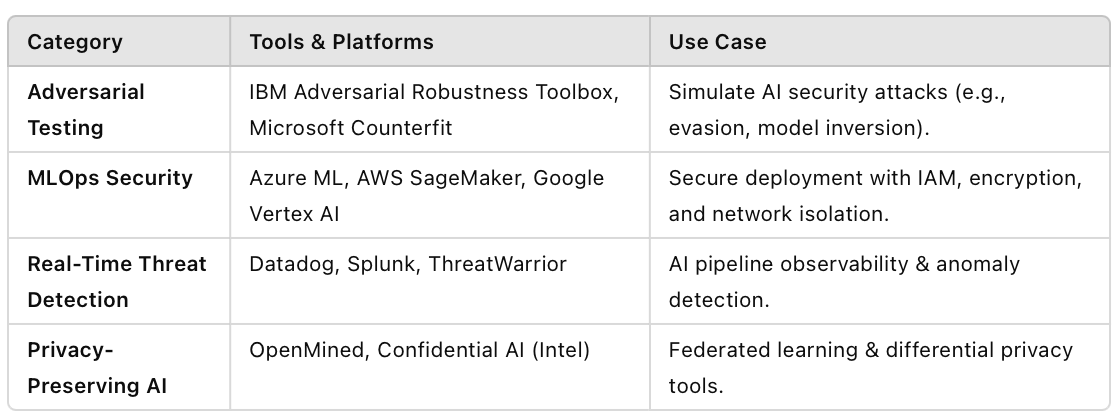
Utilize observability platforms (e.g., Datadog, Splunk) to monitor deviations in AI model behavior.
2. Automated Threat Detection#
Leverage AI-driven security tools to identify unusual patterns indicative of data poisoning, model inversion, or adversarial activity.
Example: Autoencoders & one-class SVMs for anomaly detection in MLOps pipelines.
3. Adversarial Testing & Red-Teaming#
Simulate attacks using tools like IBM Adversarial Robustness Toolbox or Microsoft Counterfit.
Conduct prompt injection testing for LLMs to evaluate vulnerabilities.
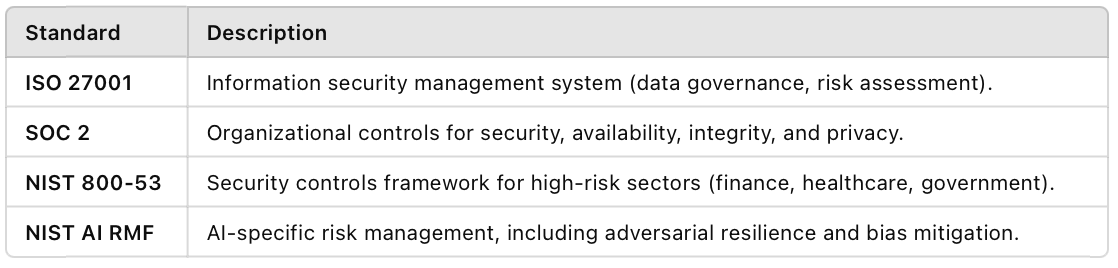
4. Compliance with Security Standards#
Organizations must align with globally recognized frameworks to formalize security best practices:
 Enlarge ↗
By adopting these standards, organizations demonstrate AI security accountability while reducing the risk of regulatory non-compliance.
AI Security Tools & Technologies#
Proactive security requires leveraging cutting-edge security tools. Here’s a breakdown:
 Enlarge ↗
Relevant Regulations & Compliance Resources#
ISO 27001: https://www.iso.org/standard/27001
NIST 800-53: https://csrc.nist.gov/publications/detail/sp/800-53/rev-5/final
NIST AI RMF: https://www.nist.gov/itl/ai-risk-management-framework
SOC 2: https://www.aicpa-cima.com/topic/audit-assurance/audit-and-assurance-greater-than-soc-2
EU AI Act: https://artificialintelligenceact.eu/
U.S. AI Bill of Rights: https://bidenwhitehouse.archives.gov/ostp/ai-bill-of-rights/
Final Thoughts: Preparing for Enterprise AI Governance#
This article outlined proactive security measures for AI, from real-time threat detection to compliance with security standards.
In Part 4, we will explore how to build an end-to-end AI governance framework, covering:
Internal AI security policies
Ethical AI deployment best practices
Continuous AI security audits