Part 4 of 4 in the AI Security for Enterprises Series
In this final part of the series, we combine everything covered so far - AI security fundamentals, platform comparisons, and proactive security measures - to focus on governance. AI security is not just about technical defenses; it also requires clear policies, risk management frameworks, compliance measures, and organizational accountability.
A well-defined AI governance framework ensures that AI deployments remain secure, ethical, transparent, and compliant with industry regulations. This article explores the key pillars of governance, from internal policies to continuous auditing and regulatory alignment.
Why AI Governance is Essential#
AI governance bridges security, compliance, and ethical considerations. Without a structured framework, organizations face risks such as regulatory violations, reputational damage, security breaches, and AI bias lawsuits.
A strong governance strategy should ensure:
Security: AI models are protected against adversarial threats, data poisoning, and unauthorized access.
Ethical AI Use: AI-driven decisions remain fair, unbiased, and explainable to users and regulators.
Regulatory Compliance: AI deployments adhere to frameworks such as ISO 27001, GDPR, SOC 2, NIST AI RMF, and the EU AI Act.
Operational Resilience: AI models are monitored, updated, and audited to prevent failures.
By integrating governance into AI systems from day one, organizations reduce risks and build stakeholder trust.
Key Pillars of AI Governance#
1. Establishing Internal AI Security & Ethics Policies#
Organizations need well-defined internal policies to govern AI security, compliance, and ethical standards. These policies should address:
Data Privacy & Protection: define how sensitive data is collected, stored, and processed by AI models.
Bias & Fairness Audits: regularly evaluate bias models and ensure fairness in decision-making.
Access Controls & Security Protocols: implement Zero-Trust AI Access, ensuring only authorized personnel can modify or deploy models.
Transparency & Explainability: AI decisions must be interpretable and justifiable, especially in high-stakes environments.
To enforce these policies, organizations should create a cross-functional AI governance committee consisting of security, compliance, legal, and technical teams.
2. Implementing AI Risk Management Frameworks#
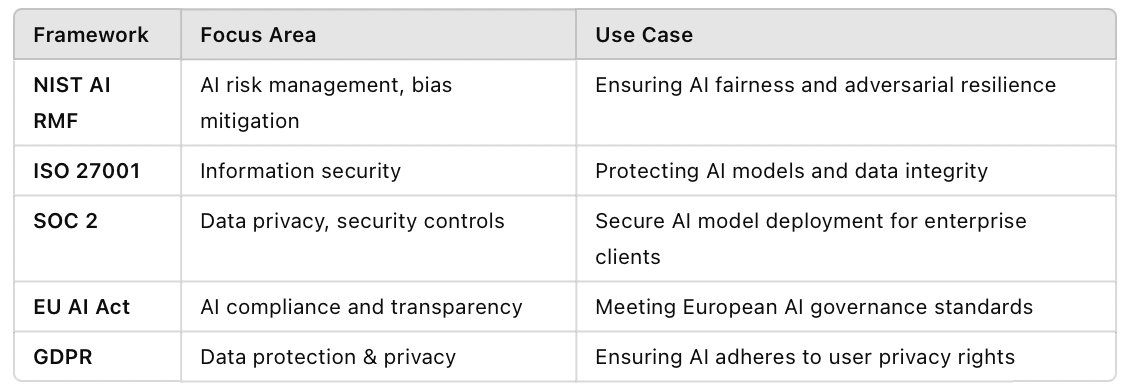
To manage AI risks effectively, enterprises should align with industry-recognized frameworks such as:
 Enlarge ↗
By integrating these frameworks, enterprises can reduce compliance risks and align AI governance with industry best practices.
3. Continuous Auditing & Compliance Monitoring#
AI security is not a one-time implementation - it requires ongoing evaluation. Organizations should:
Conduct regular security audits to detect vulnerabilities in AI models.
Implement automated compliance monitoring to track AI behavior against governance policies.
Use logging and observability tools like Splunk, Datadog, and ELK Stack to detect suspicious activity.
Benchmark AI performance against regulatory requirements to ensure sustained compliance.
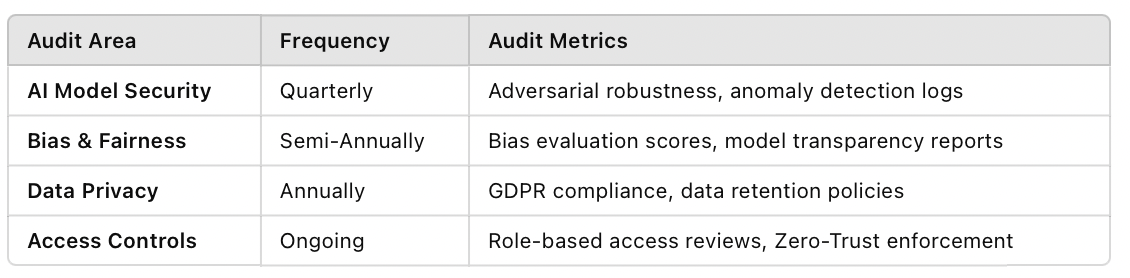
A structured audit checklist helps maintain governance consistency:
 Enlarge ↗
Regular audits reduce governance risks and strengthen AI security posture.
4. AI Incident Response & Accountability Measures#
Despite proactive security, AI systems remain at risk of attacks, failures, or compliance breaches. Organizations must have AI-specific incident response plans that define:
Threat Detection & Response Protocols: establish predefined workflows for responding to AI model anomalies.
Incident Reporting & Escalation: define who handles AI security breaches and compliance violations.
Automated Risk Mitigation: use AI-driven security tools like ThreatWarrior and Cortex XSOAR to automate threat response.
A structured AI security response playbook ensures that incidents are handled efficiently and transparently.
5. AI Governance in Action: Industry Case Studies#
Financial Sector: Ensuring AI Model Compliance#
A major bank deployed AI for fraud detection but faced regulatory pressure due to explainability concerns. By implementing NIST AI RMF and GDPR-compliant auditing, the institution improved model transparency and met compliance standards.
Healthcare Sector: Securing AI-Driven Diagnostics#
A hospital used AI for medical diagnostics but needed HIPAA compliance. By enforcing Zero-Trust AI Access and automated data privacy audits, patient data remained protected while AI-assisted decision-making improved.
These real-world cases highlight how AI governance frameworks enhance security, trust, and compliance.
The Future of AI Governance#
As AI adoption accelerates, organizations must adapt governance strategies to evolving regulations and risks. Key trends shaping AI governance include:
AI Model Watermarking: ensuring AI-generated content can be traced back to its source.
Secure Federated Learning: protecting AI models across decentralized environments.
AI Legal Compliance Expansion: Governments expanding AI-specific regulations such as the EU AI Act and U.S. AI Bill of Rights.
By continuously improving AI governance, organizations can deploy AI responsibly while staying ahead of emerging risks.
Final Thoughts: A Holistic Approach to AI Security & Governance#
This series explored:
AI Security Fundamentals: understanding risks like adversarial attacks and data privacy concerns.
AI Platform Comparisons: evaluating security capabilities across AWS, Azure, and GCP.
Proactive AI Security: implementing real-time monitoring, red-teaming, and anomaly detection.
AI Governance Frameworks: establishing internal policies, compliance auditing, and incident response plans.
AI security is not just about technology - it is about governance, ethics, and accountability. Enterprises must adopt a holistic approach to protect AI systems while ensuring compliance and trust.
This is just the beginning. As AI regulations and threats evolve, so must our strategies. Organizations that invest in proactive AI security and strong governance today will lead the AI-driven world of tomorrow.
This completes the AI Security for Enterprises series. If you have thoughts or questions, let’s continue the conversation.